What people often assume
Consequence should stop it.
- He knows tomorrow matters.
- He already made a good decision once.
- He understands what this could cost.
- So why go back?
The usual answers sound simple. The behavior is not.
Addiction often looks mysterious from the outside. But underneath the consequences, the identity, and the fear is a familiar structure: something opens, the system leans forward, an action runs, something settles, and the brain remembers.
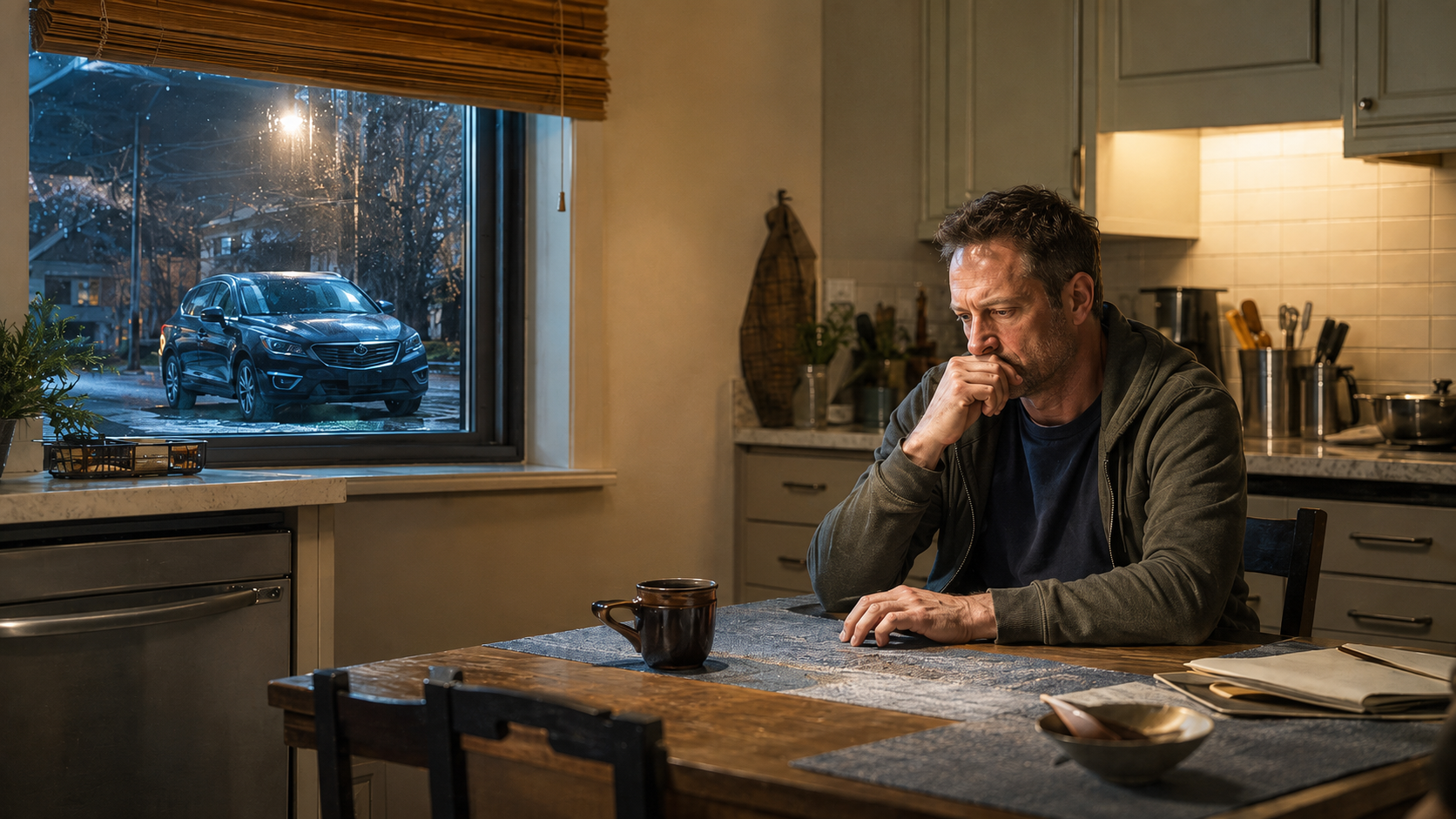
He leaves it in the car. That is the plan. The house is quiet. The day is over. Tomorrow matters. There is something important in the morning—a meeting, an interview, a promise to show up differently. He has already made one good decision: he did not bring it inside. The powder is outside. That should count.
For a while, it does. He moves through the evening like anyone else. Lights off. Doors checked. The small routines of ending a day. Nothing dramatic. Nothing urgent. But something is not finished.
It does not arrive as a thought. It arrives as a pull. A quiet, persistent sense that something has been left open. The mind drifts toward the driveway. Toward the car. Toward the small invisible fact waiting out there. Not loudly. Not all at once. Just enough to keep returning.
He tries to ignore it. He tries to sleep. But the body has already leaned forward. By midnight, it is no longer in the car. It is in the room. And the night begins again.
From the outside, this can look like weakness, self-destruction, or a person who simply does not care. But the behavior is not random. It has structure.
You have seen this architecture before—in biting, smoking, checking, scrolling, eating, and returning. Addiction is where the same machinery becomes impossible to ignore.
Addiction usually does not begin as ruin. It begins as something that works.
Some substances make the world feel easier, faster, quieter, or more manageable. For a moment, the system seems to improve.
The behavior is no longer only about feeling better. It becomes a reliable way to end pressure, silence noise, or settle an unfinished state.
The shift is gradual enough to hide itself. What began as a choice can start to feel like a requirement just to get back to baseline.
Some loops whisper. Some shout. The difference is often not a different kind of person, but a louder signal and a faster learned route.
When a behavior reduces internal pressure fast, the system marks it as important. The faster and louder the relief, the stronger the learning can become.
When the signal is loud, the brain is not doing a fair comparison between life outcomes. It is comparing exits.
Missed opportunities. Health risks. Damaged trust. Money. Shame. The person may know all of it clearly.
Which action ends this feeling right now?
The loop is not asking what is wise over time. It is asking what closes the signal fastest.
What you are watching in addiction is not a different kind of person. It is the same loop, at a different volume.
A habit, a preference, a familiar route. The person still has more room to delay, redirect, or ignore it.
The route gets louder. The loop returns more often. Consequences begin showing up, but the behavior still reliably ends the feeling.
The system narrows around completion. The route can outrun consequence, intention, and understanding.
This exhibit is not here to flatten addiction into a slogan. It is here to make the structure visible. Once you can see the shared engine beneath the story, the behavior stops looking random. The person stops looking mysterious. And the loop stops feeling like a character verdict.
That does not make the consequences smaller. It does something else. It makes interruption thinkable. It creates the first inch of space between I am this and this is running in me.
And once you see it here, you start seeing the same architecture in other rooms too.
You are inside an exhibit
Return to the room that brought you here, step beneath the behavior into the shared mechanism, or choose a different doorway.