Working Preview V64N4
Main Path Find Your Doorway → Oral Habits → Teeth Grinding & Jaw Clenching
A gray-area exhibit: return to doorways
Where structure, sleep, sensation, and circuitry meet

Teeth Grinding & Jaw Clenching

Sometimes the bite creates the signal. Sometimes the nervous system keeps running the movement. Often, both stories are true at once.

This exhibit does not ask dentistry and neuroscience to compete. It asks a more useful question: what is being protected, corrected, repeated, or learned?

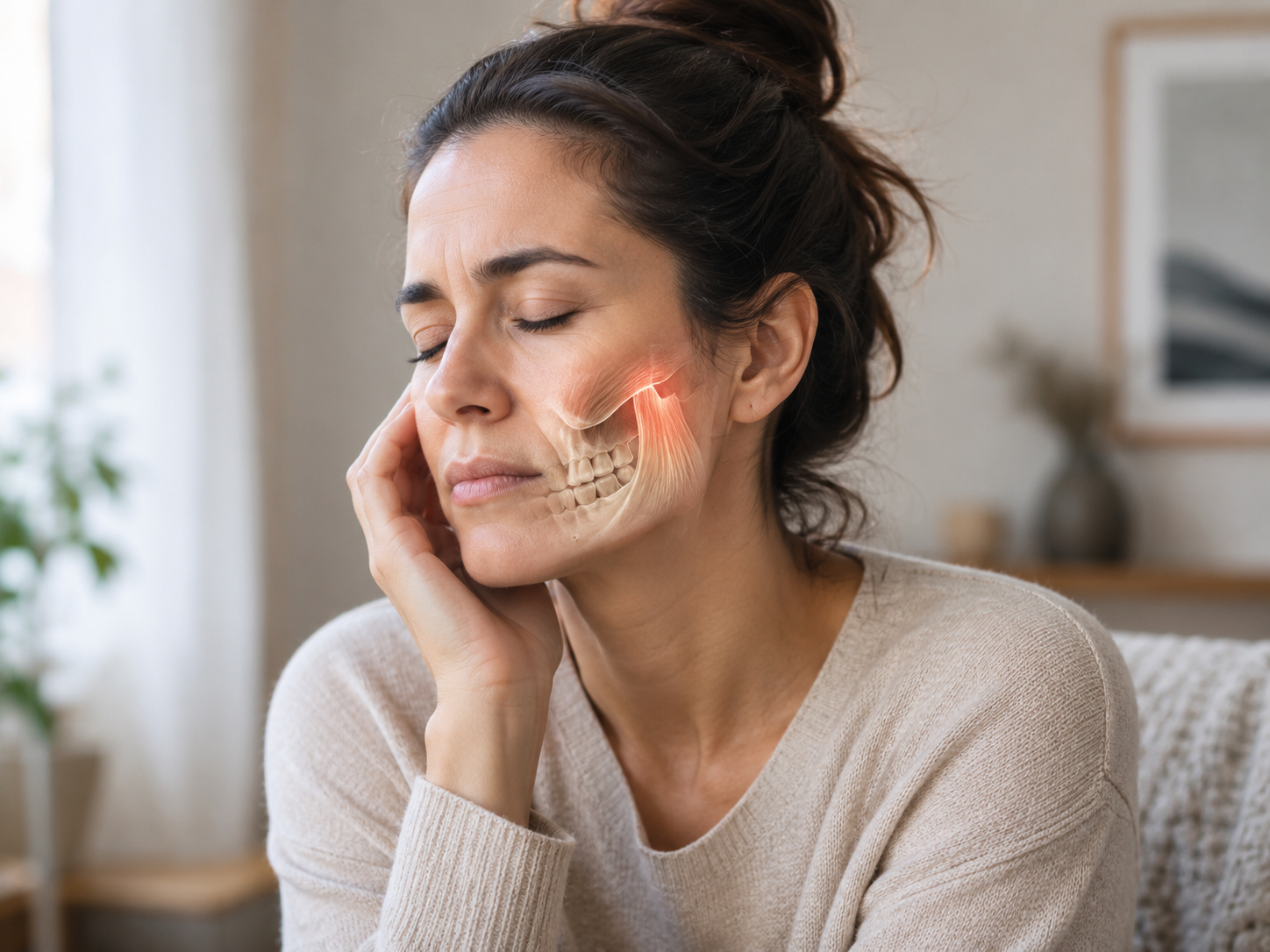
A woman holding her jaw with a subtle anatomical overlay showing the jaw muscles, teeth, and joint.
The jaw can be carrying pain, pressure, protection, habit, or all of them at once.
Recognition scene

The evidence often appears before the explanation.

Morning jaw soreness. A cracked filling. Flattened teeth. A partner who heard the grinding. Or a workday spent with the jaw held tight without noticing.

The dentist tilts the light and studies the wear marks. The edges of several teeth are flatter than they should be. One filling has a hairline crack. The muscles along the jaw feel tender when pressed.

“You’re grinding,” the dentist says.

That may be exactly right. The teeth are showing the footprint. But the footprint does not always reveal what started the walk.

A night guard may protect the enamel. A sharp edge may need smoothing. A high restoration may need correction. The bite may matter. The joint may matter. Sleep may matter. The motor pattern may matter.

The useful question is not, “Is this dental or neurological?” It is, “Which layer is active here?”

Two related behaviors, not one identical problem

Daytime bracing and nighttime bruxing happen in different rooms.

The jaw can be active while awake or during sleep. The clues, triggers, and useful forms of leverage are not always the same.

Bruxism is the clinical umbrella term. Dentists often use bruxism—or the informal verb bruxing—to describe grinding and clenching. The broader clinical definition can also include jaw bracing: sustained muscle tension or holding the jaw in position, sometimes without the teeth touching.

Awake clenching or bracing

The jaw holds while the person is conscious.

It may appear during concentration, driving, lifting, frustration, computer work, or quiet focus.

  • The teeth may press together.
  • The jaw may brace even without tooth contact.
  • Awareness often arrives late.
  • Context and habit can become strong cues.

The movement may function as pressure, readiness, rhythm, or concentration.

Sleep bruxism

The jaw is active while the person is asleep.

The clue may be morning stiffness, tooth wear, a fractured restoration, or a sleep partner hearing the sound.

  • The movement can be rhythmic or sustained.
  • Sleep arousals may be relevant.
  • Breathing and sleep disorders may need evaluation.
  • A daytime awareness strategy cannot operate during sleep.

Nighttime protection and sleep evaluation may matter even when the person feels no daytime urge.

What dentistry can genuinely change

A physical correction can be real leverage.

The Loop Hypothesis should never turn a local dental problem into “just circuitry.” Structure can create signal.

When the trigger is physical

A high filling, damaged restoration, sharp tooth edge, unstable contact, jaw injury, muscle guarding, or altered joint movement can produce real sensory input.

Sometimes the dentist removes the stone from the shoe.

If that input was repeatedly recruiting the jaw, correcting it may reduce or stop the behavior. That is not merely masking the loop. It may remove the cue that kept launching it.

When protection is still essential

A night guard or splint may distribute force and protect teeth, restorations, and joints. That can be valuable even if it does not eliminate the underlying muscle activity.

Sometimes the dentist protects the foot while the nervous system keeps walking the old way.

Protection and explanation are different jobs. A treatment can be worthwhile even when it does not answer why the motor pattern keeps returning.

The two-way loop

Structure can drive repetition. Repetition can alter structure.

This is the central gray area. The relationship may run in both directions.

Physical signal

Bite contact, tooth edge, muscle pain, joint sensation, or an appliance changes what the jaw feels.

Jaw response

The system clenches, braces, shifts, or grinds to change the sensation or stabilize the region.

The bite may start the loop.

The loop may outlive the bite.
Short-term change

Pressure changes, a contact feels different, the jaw feels temporarily held, or the system gains a moment of relief.

New physical signal

Repeated force creates wear, soreness, inflammation, cracking, or altered contact—giving the jaw another cue to answer.

Simple mechanism display

Walk through the jaw loop one station at a time.

The loop can begin with a physical signal, a state change, or a learned context. The movement may then become easier to select.

1

Signal appears

A contact feels wrong, the system becomes alert, concentration deepens, or sleep activity brings the jaw online. The starting signal is not identical for everyone.

Signals and leverage

Sort each intervention by the job it is doing.

No single explanation has to carry the whole case.

1

Protect tissue

Guards and splints may reduce tooth damage and distribute force.

Protection
2

Correct a signal

Repairing a sharp edge, unstable restoration, or meaningful contact problem may remove a true trigger.

Structure
3

Change movement

Jaw-position work, physical therapy, awareness, and clinician-guided retraining may alter how the muscles are recruited.

Motor pattern
4

Investigate sleep

Sleep quality, arousals, breathing, medications, and other contributors may require evaluation beyond the bite.

Whole system
5

Lower loop pressure

Understanding, context, sensory input, sleep, stress physiology, and chemistry may matter when the route continues beyond the original cue.

Circuit gain
Chemistry and circuit pressure: Brain chemistry may influence how ready the jaw system is to brace, clench, or grind, but this exhibit does not name a specific compound or present chemistry as a dental substitute. The chemistry belongs later, in the Glutamate and Volume Knob galleries, alongside sleep, structure, movement, and sensory input.
Forward paths

Follow the question that remains.

Teeth grinding sits at the border of dentistry, sleep, movement, sensation, and habit circuitry. The next room depends on which layer feels most active.

Read the manuscript pathway

The Reading Room places clenching, grinding, oral loops, sensory input, and circuit pressure within the larger manuscript. This exhibit keeps the gray area visible rather than forcing one cause.

Open the Reading Room