A tongue or fingertip checks an edge, ridge, sore spot, or texture.
Inside the Oral Habits doorway
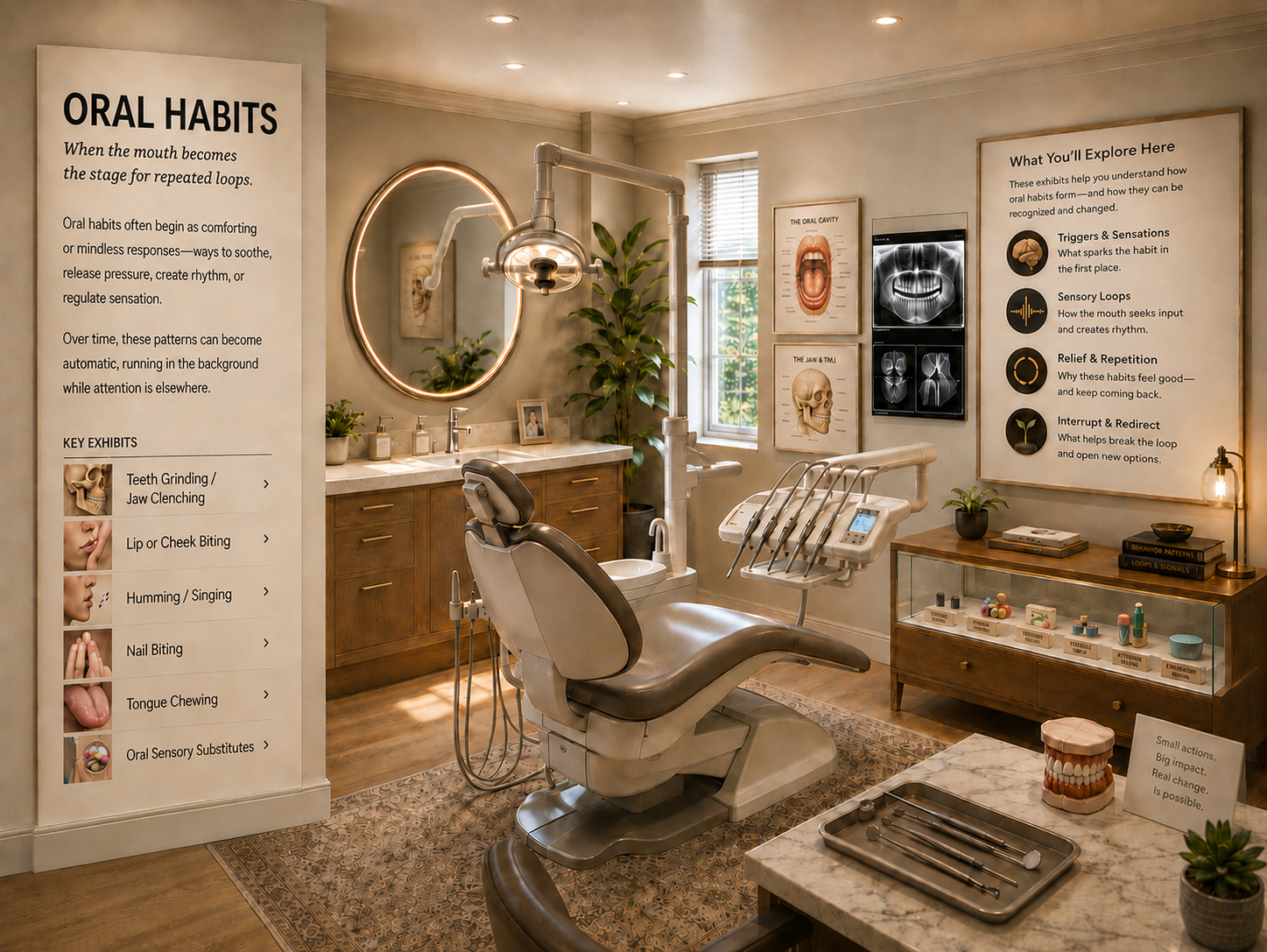
Oral Habits
The mouth is one of the nervous system’s highest-resolution tools. It can sense, test, brace, chew, smooth, and regulate — often before awareness arrives.
This room brings together several kinds of oral loops without pretending they are all the same. The target changes. The nervous-system job may still rhyme.
A Moment Inside the Loop
Behind Closed Lips
He is driving, thinking through a problem, eyes on the road. Nothing seems wrong. The radio is low. Traffic is ordinary.
Then awareness arrives late.
His tongue is already pressed against his teeth. His jaw has already shifted. The movement has been running quietly in the background, hidden behind closed lips.
That is the strange privacy of oral loops. From the outside, almost nothing is happening. From the inside, a small motor has been running for miles.
Mechanism: In many oral loops, the body moves first and awareness arrives second.
The Loop That Opened the Door
A private oral motor pattern began the search behind The Loop Hypothesis.
It ran before awareness, changed with sensory input, and resisted decades of attempts to stop it. That pattern was tongue chewing. It is not being presented here as the room’s main attraction or as a finished exhibit. It is the origin plaque—the narrow doorway that eventually opened onto a much larger family of oral loops.
The exact behavior was unusual. The architecture underneath it was not.
Exhibits in This Room
Start with the exhibit that is open widest.
Oral loops can smooth an edge, hold pressure, create rhythm, or change a sensation. The surface varies. The nervous-system logic can still rhyme.
Oral Habits
Also Open
Other completed exhibits in this room.
Lip & Cheek Biting
An inside-mouth edge becomes a target, and the fix can create the next unfinished spot.
Enter exhibit →Open exhibitTeeth Grinding, Jaw Clenching & Bruxing
Where dental structure, muscle pressure, sleep, and learned motor circuitry can meet.
Enter exhibit →Open exhibitHumming & Repetitive Vocalization
Sound and rhythm as sensory regulation, concentration, or automatic repetition.
Enter exhibit →Open exhibitWhat holds the room together
The surface changes. The mouth’s job changes too.
The mouth is not one loop system. It is a collection of powerful sensory and motor tools. The tongue tests. The teeth cut and brace. The lips and cheeks provide texture. The jaw creates pressure. The voice creates rhythm.
The mouth tries to make a surface feel even, clean, or complete.
The jaw holds pressure during sleep, focus, stress, or physical effort.
Chewing, humming, rhythm, and pressure can change internal state for a moment.
A common shape: something is noticed → the mouth moves → the sensation changes → brief completion or regulation → the route becomes easier to repeat.
Recognition without overdiagnosis
Oral habits exist on a spectrum.
Many people chew, bite, clench, grind, or hum occasionally. The presence of a repetitive behavior does not automatically make it a disorder. Concern rises when a pattern causes injury, dental damage, pain, sleep disruption, significant distress, concealment, or repeated loss of control.
Mild for many. Painful or damaging for some. Similar circuitry can run at very different volume.
Future Exhibits
This room will keep growing.
Planned for later openings
Gum, Pen & Object Chewing
Tongue Pressure & Checking
The Loop Behind Closed Lips
The tongue-chewing origin story may eventually open as a full exhibit, but only when it has a complete purpose beyond disclosure itself.
A completed museum wing
Different behaviors. One larger question.
Nail biting, lip and cheek biting, and jaw clenching do not look identical. One chases an edge. One revisits an inside-mouth spot. One holds pressure through the jaw. But each asks us to look beneath the visible action and ask what signal the nervous system is trying to change, settle, or finish.
Where chemistry belongs
Sleep, stress, stimulation, and brain chemistry can change how loud an oral signal feels before the movement begins. The individual exhibits leave that chemistry unnamed. The Glutamate and Volume Knob galleries take up the mechanism in its proper context.
Where this room leads
One room. Several paths.
Someone may enter through tongue chewing, cheek biting, grinding, nail biting, or sound. The doorway they choose should feel specific. But each path can still lead back to the same deeper question: what signal is the loop trying to finish?
From recognition to mechanism
Oral Loops
This doorway connects to the manuscript pathway on tongue chewing, cheek biting, grinding, humming, sensory gating, and the chemistry of background pressure.
Ready to look beneath the behavior? Begin with the shared circuit, then follow the five-part mechanism path without losing your place.